
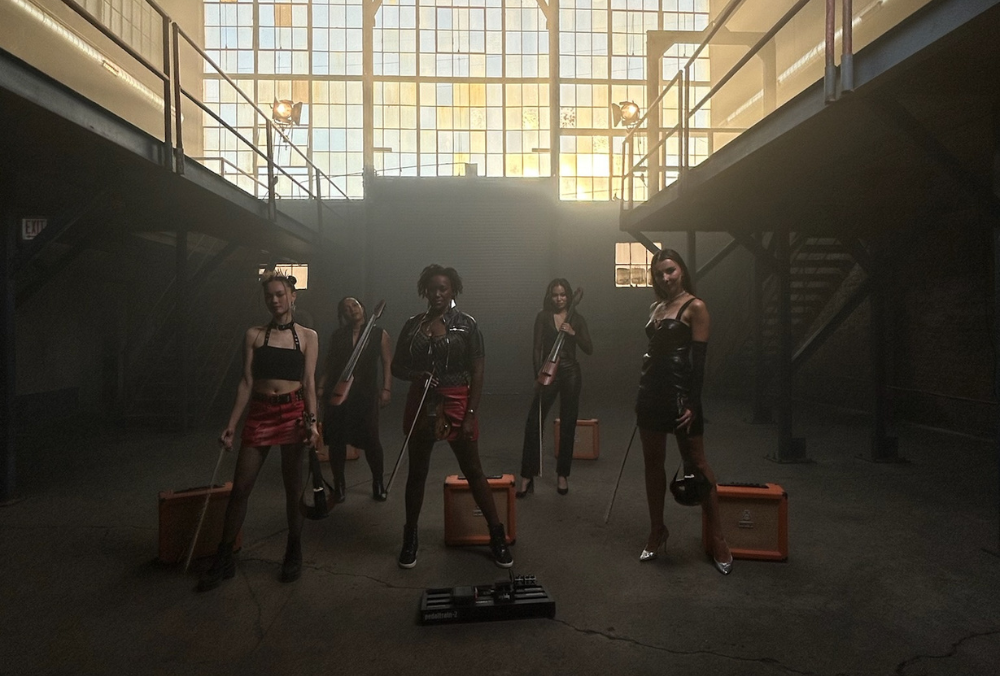
There’s something magnetic about watching musicians push the limits of what their instruments can do. Chicago’s Electric 5 takes that idea to the extreme with their bold, electrified cover of The Rolling Stones’ “Paint It Black.” It’s not just a reinterpretation, it’s a full-on reinvention that fuses classical technique with the pulse of modern rock.
The five members: Adia, Kelsee Vandervall, Erica Carpenedo, Violetta Todorova, and Lillian Pettit, recorded the track live at Coda Room Audio in Chicago. With no backing tracks or looping, every sound captured is a product of timing, trust, and synergy. Mixed and mastered by Grammy-winning engineer James Auwarter in London, the song sounds expansive yet grounded, maintaining the raw edge of a performance you could almost reach out and touch.
Arranged by Dusan Sarapa and Adia, “Paint It Black” trades in its signature sitar riff for a storm of strings. The cellos rumble with rhythmic urgency while the violins carry both melody and emotion, creating a tension that builds and breaks with cinematic precision. It’s a darker, more visceral take on the original: one that captures the spirit of rebellion while speaking a new language entirely.
Electric 5’s version doesn’t rely on distortion or spectacle, but on the raw electricity that happens when five players lock in and breathe together. That connection — physical, instinctive, and fearless — is what gives their performances weight.
Following their standout take on Metallica’s “Enter Sandman,” the quintet continues to defy expectations. They’ve carved out a sound that lives between worlds: classical without restraint, rock without noise, and experimental without losing form. “Paint It Black” cements that balance, showing how live performance can still feel urgent in an age dominated by polish and presets.
Electric 5’s rendition feels like a conversation across generations: a 1960s anthem reborn through 21st-century instruments. It’s proof that when you strip everything back to real musicianship, there’s still nothing more powerful than five strings and a shared heartbeat.