

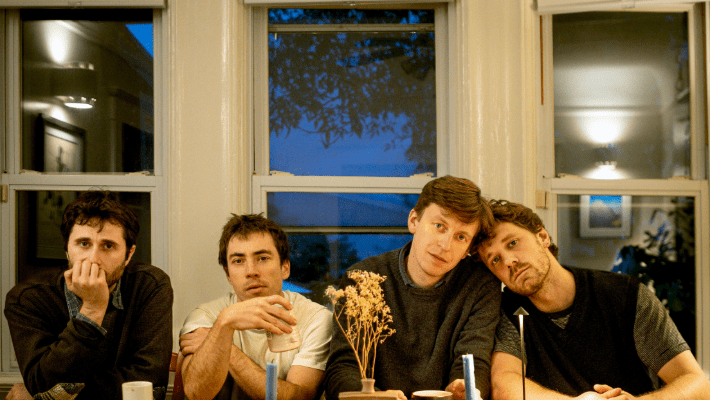
To hear the members of Mildred tell it, their band didn’t form so much as fall into place. Around 2022, three of the four members—singer-guitarist Henry Easton Koehler, Jack Schrott, and singer-bassist Matt Palmquist—were living together in a Berkeley house, bonding over beers and the music of Silver Jews. They were in their early 30s, balancing day jobs and academic pursuits, all while navigating the lingering stillness of the post-pandemic world.
During those quiet months, drummer Will Fortna would drop by during visits from out of town, and their casual hangouts inevitably gravitated toward instruments. What began as impromptu jams slowly evolved into something more substantial. Those sessions eventually coalesced into Fenceline, the band’s full-length debut and arguably one of the most endearing indie sleepers of 2026.

The record feels like a spiritual successor to the work of David Berman, albeit one relocated to Northern California and infused with the warm, collaborative spirit of The Band or Crosby, Stills, Nash & Young. Fenceline is a collection of low-key, highly observational character studies set to quietly invigorating folk-rock. The production captures the band’s natural chemistry, with instrumental parts that lock together like complex embroidery.
“It feels delicate and tough at the same time, created by a true band whose members appear to be genuinely ego-less.”
The band maintains a strictly democratic approach to songwriting. Whether it’s the sudden, jarring cut of a guitar solo on “Fish Sticks” or the campfire-like harmonies on “Charlie,” the record is defined by small, intentional moments that resonate deeply upon repeated listens. When speaking with Koehler and Fortna, they were adamant about the lack of hierarchy within the group, describing Mildred as an “organic” co-op of friends rather than a project with a singular leader.
For the band, the transition from living-room jam sessions to a serious touring outfit was gradual. A tour with Naima Bock served as a turning point, signaling that their creative partnership was something worth pursuing with greater intent. Despite the professionalization of their craft, they remain grounded in the same ethos that brought them together: a shared love for listening to music and the simple joy of playing it in a room together.
As they look toward their next batch of songs, the collaborative spirit remains the driving force. With everyone contributing to arrangements and production, Mildred has managed to create a sound that feels both timeless and entirely their own—a testament to what happens when four friends stop overthinking and start playing.